

Can VT Preserve Patient Access and Pull off Structural Reform?
Stat v.24 – June 18, 2026
First, don't forget to make a plan to join next week's discussion with leaders behind The University Hospitals Health System in Cleveland, OH and their remarkable turn around. They will share many lessons that could help us here in Vermont. More details here. RSVP not required but it will help you get in to OnLogic more easily.

Can Vermont Preserve Access to Services and Pull Off the Structural Changes Needed to Reduce Healthcare Costs?
The challenge is daunting. In 2025, eight of Vermont’s hospitals lost money. A 2024 report estimated that the combined deficit of Vermont’s 14 hospitals could reach between $700 million and $2.4 billion by 2030. In May, the investigative “Liaison Team” led by Mike Smith and embedded at UVM Health recommended that the network reduce its costs by at least $300 million over the next three years .
We simply can’t escape that there is no realistic revenue scenario to sustain the current trajectory of Vermont’s hospitals. Restructuring how we deliver and finance hospital services, therefore, is imperative, and hard work. Everyone will be affected and compromises statewide will be necessary.
In Vermont’s culture of small, local, and independent, not-for-profit healthcare providers, the commitment and effort required for collective action and decision-making across organizations has historically been insufficient. But change is now underway, and a lot is happening quietly and diligently that shows promise.
Fitting Many Moving Parts Together
Last year, the legislature put several strategies into motion. We at VHC911 think these efforts could knit together to improve the affordability, sustainability, and quality of our hospital system, but success is far from guaranteed.
Regionalization, Act 68 of 2025 directs the Vermont Agency of Human Services (AHS) to lead a regional transformation process. The effort recognizes that smaller hospitals may need to adjust the services they provide and share resources more effectively. Rural hospitals are closing across the country, and Vermont won’t be immune to this trend without meaningful changes. The process also highlights the role of our larger hospitals, including the University of Vermont Medical Center (UVMMC), in supporting smaller hospitals by sharing services such as specialty care and telehealth. Of course, UVMMC must also reduce their own operating costs.
Public updates about this process have been few, but people involved report that hospital leaders are meaningfully engaged. We are eager for substantive details and expect these will emerge when hospitals file their 2027 budget proposals at the end of June. That will be the beginning, we anticipate, of an ongoing process into future years.
Fingers crossed the transformation plans will have strategies that meaningfully reduce costs, deliver administrative efficiencies, and provide regional access to services. While it can be difficult to accept when a hospital shifts gears, it is also true that patient safety is at risk when hospitals deliver specialized services infrequently or perform too few procedures to maintain proficiency.
S.189 became law this week. That law requires hospitals to hold public comment periods before implementing proposed service line changes. It is important that citizens provide input on how the changes will impact their communities.
Vermont Will Wait Another Year for Reference-Based Pricing
Act 68 also directs the GMCB to establish rules for "Reference-Based Pricing" (RBP), a strategy several states have used to bring down health insurance costs. Essentially, RBP mandates that hospitals charge insurance at a factor of Medicare costs. For example, in Oregon, for nearly 300,000 public-sector employees and their families, this formula was limited to 200% of what Medicare will pay and generated over $160 million in savings in the first two years.
S.190, a bill that gave GMCB the authority to begin applying RBP in 2027 to the health insurance benefits of public-school employees and to the Qualified Health Plans on the state exchange, was vetoed this week by Gov. Scott. The bill would have been a jump start and saved money. However, the GMCB is writing rules to bring all commercial insurance under RBP in 2028, so we should still see savings a year later.
As hospitals gain efficiencies through streamlined operations and better regional coordination, it is essential that rate payers see those savings reflected in their premiums. RBP is a proven strategy to achieve this goal.
The Rural Health Transformation Program
Another promising initiative is The Federal Rural Health Transformation Program (RHTP). It could bring $195 million a year into Vermont for each of the next five years. The program was created to support rural health care and help mitigate federal reductions to Medicaid and Health Exchange subsidies. RHTP funding will not replace lost Medicaid coverage or fully offset Vermont’s Medicaid losses. However, it does create a rare opportunity to invest in shared infrastructure and new care models that Vermont could not otherwise afford.
What Does Transformation Look Like?
This work has limited public exposure for several reasons. Drawing down the RHTP funds requires significant negotiations with the federal government for each initiative. In addition, hospitals are reluctant to provide details about substantial changes to their operations prior to filing their budgets with the Green Mountain Care Board. Even so, plans submitted to AHS in April point to six broad categories of transformation.
Hospital Optimization & Efficiency. Hospitals are actively working on reducing operating expenses in response to GMCB requirements.
This work requires complex planning to change long-standing business and clinical operations, reduce administrative and management costs, and shift or eliminate services that lose money when they can be offered more cheaply elsewhere (e.g. shifting services from the hospital to less expensive community settings). AHS supports this work through Act 68 transformation grants, advanced analytics & modeling, and RHTP initiatives that can strengthen lower-cost community-based services. We expect these hospital level changes will roll out over time as hospitals finalize plans and prepare implementation.
Regionalization of Services. Hospitals are also planning across organizational boundaries. Smaller rural hospitals increasingly recognize they must work together to stay afloat. Hospital leadership teams are engaging with one another and with AHS to bring ‘system-ness’ to Vermont’s historically fragmented health care system. Examples include:
Shared business and administrative services (e.g. insurance, human resources, legal, and revenue-cycle management);
Regional coordination of service delivery, including mental health, coordination of care and transfer to appropriate sites based on need and capabilities, shared clinical and radiology services; and
Shared technology platforms that are described below as part of RHTP investments.
Regional and statewide shared services have substantial potential. One example is The New England Health Collaborative Network (NEHCN), whose hospital members include Copley Hospital, Northwestern Medical Center, Brattleboro Memorial Hospital, Grace Cottage Hospital, Gifford Hospital, Springfield Hospital, as well as health centers and other community providers (Northern Tier Center for Health, Lamoille Health Partners, Lamoille Home Health & Hospice, Northern Counties Health Care, Central Vermont Home Health and Hospice, and VNA & Hospice of the Southwest Region).
The NEHCN has expanded the array of shared business and administrative services available to members and is considering shared technology platforms that could be supported through RHTP. Other multi-hospital initiatives are also emerging across the state, including regional planning for mental health services and a larger hospital providing radiologist support to a smaller hospital.
Primary Care (Blueprint) Modernization. It’s not all about hospitals. Active planning is underway to leverage RHTP funding to invest in and substantially strengthen Vermont’s foundation of advanced primary care. This includes standards tied to a new payment model designed to enhance access, preventive services, coordination with specialty care, complex care management, and integration of mental health & substance use services.
These new investments should increase capacity to deliver care for people with complex needs while also decreasing the amount of time spent on non-clinical administrative functions such as reporting. The investments would also expand Vermont’s Community Health Teams (CHTs), which support primary care practices with nurses, care coordinators, social workers, and licensed counselors.
In addition to Medicaid, commercial insurers (BCBSVT, MVP) have signaled a willingness to work toward aligned standards and payment models. If successful, these changes would substantially improve access to integrated primary care, mental health, and substance use services.
Expansion of Community Based Services. Alongside Blueprint modernization, RHTP investments would strengthen services that work closely with advanced primary care practices and CHTs. These include mental health urgent care, mobile integrated health services, and treatment options in pharmacy settings. Collectively, these initiatives could help shift appropriate care from hospitals to the community and improve outcomes for people with complex needs.
Technology Advancements. RHTP also creates an opportunity to invest in technology and health information systems that support the broader transformation agenda. Planned technology initiatives include:
A shared electronic health record (EHR) platform to improve information sharing, coordination, quality, and patient transfers while reducing unnecessary and redundant tests and procedures;
Expanded use of technologies that integrate with EHRs, including use of telehealth, e-consults, remote patient monitoring, and AI scribe tools to reduce documentation burden and allow more direct patient interaction;
A centralized, statewide coordination and transfer center. Hospital leadership teams have widely called out the need for improved coordination and transfer capabilities because smaller Vermont hospitals are often bypassed and patients are transferred out of state. The state is working with hospitals, EMS & EMT, and other stakeholders to plan a single, centralized center to coordinate transfers based on patient needs, while keeping patients as close to home as possible. This initiative will address care coordination and transfer needs between hospitals, between hospitals and post-acute care settings, and incorporate hospitals across borders that are important to caring for Vermonters. A smaller hospital, for example, could boost its revenue by caring for a patient in recovery. Today that hospital misses out on that revenue because the hospital doesn’t get called. And the patient and family face the inconvenience of going further away for care.
A statewide, closed-loop referral platform to help address Health Related Social Needs (HRSNs). These platforms connect health care providers with the community organizations that address HRSNs, support shared care plans, and improve coordination across medical and non-medical services. These platforms have demonstrated robust adoption, helping to address the social-demographic needs that are often the major driver of poor health outcomes.
Analytics. One of the greatest needs expressed by hospitals and other providers is for advanced analytics and modeling that can help guide complex transformation, including how to configure cost-effective services that will meet needs in communities across the state. Many organizations lack data and analytic capabilities required to redesign services in ways that are both cost-effective and responsive to community needs. As part of its transformation support, AHS is procuring advanced analytic services that will help each Vermont hospital, and the system overall, with strategic, data-guided insights.
What This Means Going Forward. Collectively, the transformation efforts underway (Table 1) represent an inflection point and a unique opportunity for Vermont.
Table 1. Summary of transformation initiatives underway in Vermont
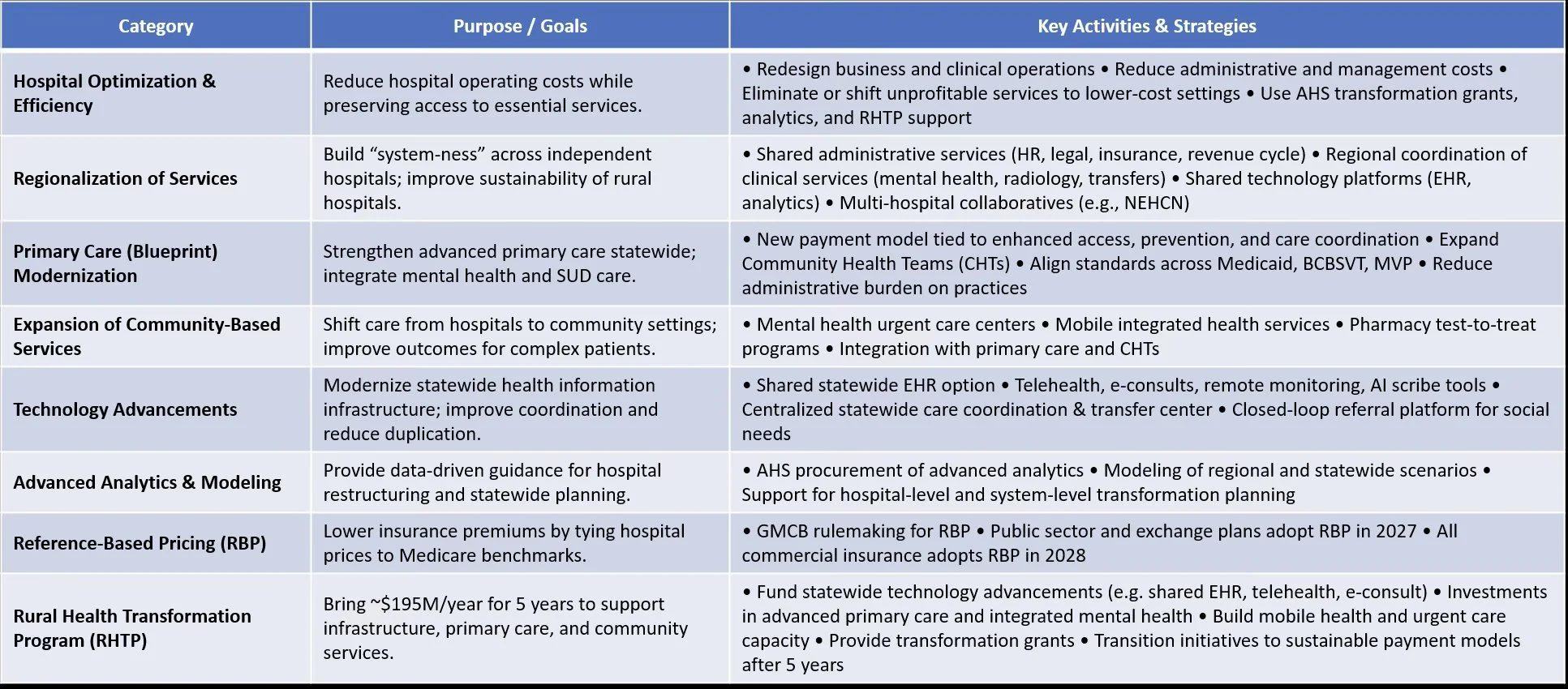
The scope of transformation and investments available through the RHTP are the most substantial that the state has undertaken. Healthcare costs and affordability are forcing functions that have reached a crisis point. GMCB regulation to reduce hospital costs, combined with AHS-led transformation initiatives to build more effective health services, creates a unique opportunity.
It is a unique time in our state’s healthcare history, and it is critical for Vermonters to be aware of these efforts, monitor progress, and to hold public officials accountable. It is essential to know whether the governor, GMCB, AHS, hospital leadership, BCBSVT, MVP, and others will implement these changes effectively to improve healthcare and affordability for Vermont’s citizens, families, and businesses.
VHC911 will continue to monitor progress and inform the public as these potentially robust transformation initiatives unfold.
Vermont Healthcare 911 (VHC911) is a broad coalition united to combat the high cost of healthcare in Vermont. The coalition is composed of business owners, labor leaders, healthcare providers, civic and political leaders of all parties and represents about 200,000 Vermonters.